
70 key terms every OEM manufacturer needs to understand when transitioning from one-time equipment sales to recurring service revenue.
Equipment-as-a-Service (EaaS) is transforming how industrial manufacturers create and capture value. But the field comes with its own vocabulary – a mix of terms from subscription economics, IoT technology, industrial finance, and business model innovation.
This glossary is designed for decision-makers at OEM machinery companies exploring or scaling EaaS. Every definition is grounded in real-world implementation experience, not theory alone.
Sources: This glossary draws on academic research from the University of St. Gallen and ETH Zurich (notably Wortmann, Gebauer, Lamprecht & Fleisch, 2024), practical insights from 75+ EaaS implementation projects, and current industry standards.
No terms found for "".
The foundational ideas behind Equipment-as-a-Service. Start here if you are new to the topic.
A business model in which an equipment manufacturer provides its products as an ongoing service solution rather than a one-time sale. The OEM bundles the equipment with lifecycle services – maintenance, monitoring, repairs, upgrades, and often financing – into a recurring revenue contract. Customers pay for usage, outcomes, or availability instead of owning the asset outright.
EaaS represents a fundamental paradigm shift for manufacturing companies. It moves them from a “sell and forget” logic toward a “provide and perform” model where value is created continuously over the equipment’s lifecycle. At the end of 2023, the global EaaS market reached $21.2 billion, while less than 1% of equipment sales were executed under EaaS contracts (IoT Analytics, March 2024).
Kaeser Kompressoren does not just sell compressors. With their compressed air as a service model, customers pay per cubic meter of compressed air consumed – similar to how they pay for electricity or water. Kaeser owns, monitors, maintains, and optimizes the compressors on-site.
Related: Product-as-a-Service (PaaS), Servitization, XaaS | Deep Dive: What Is Equipment-as-a-Service?
The academic and strategic framework term for business models where product companies bundle their physical products with services to deliver integrated product-service systems. PaaS is the broader conceptual category under which EaaS falls.
The term was developed through research at the University of St. Gallen and ETH Zurich based on analysis of over 200 companies transitioning toward service-based models. PaaS explicitly avoids being reduced to any single monetization scheme (such as pay per use) and instead encompasses the full spectrum of how products can be offered as services.
Related: EaaS, PaaS Navigator, Product-Service System
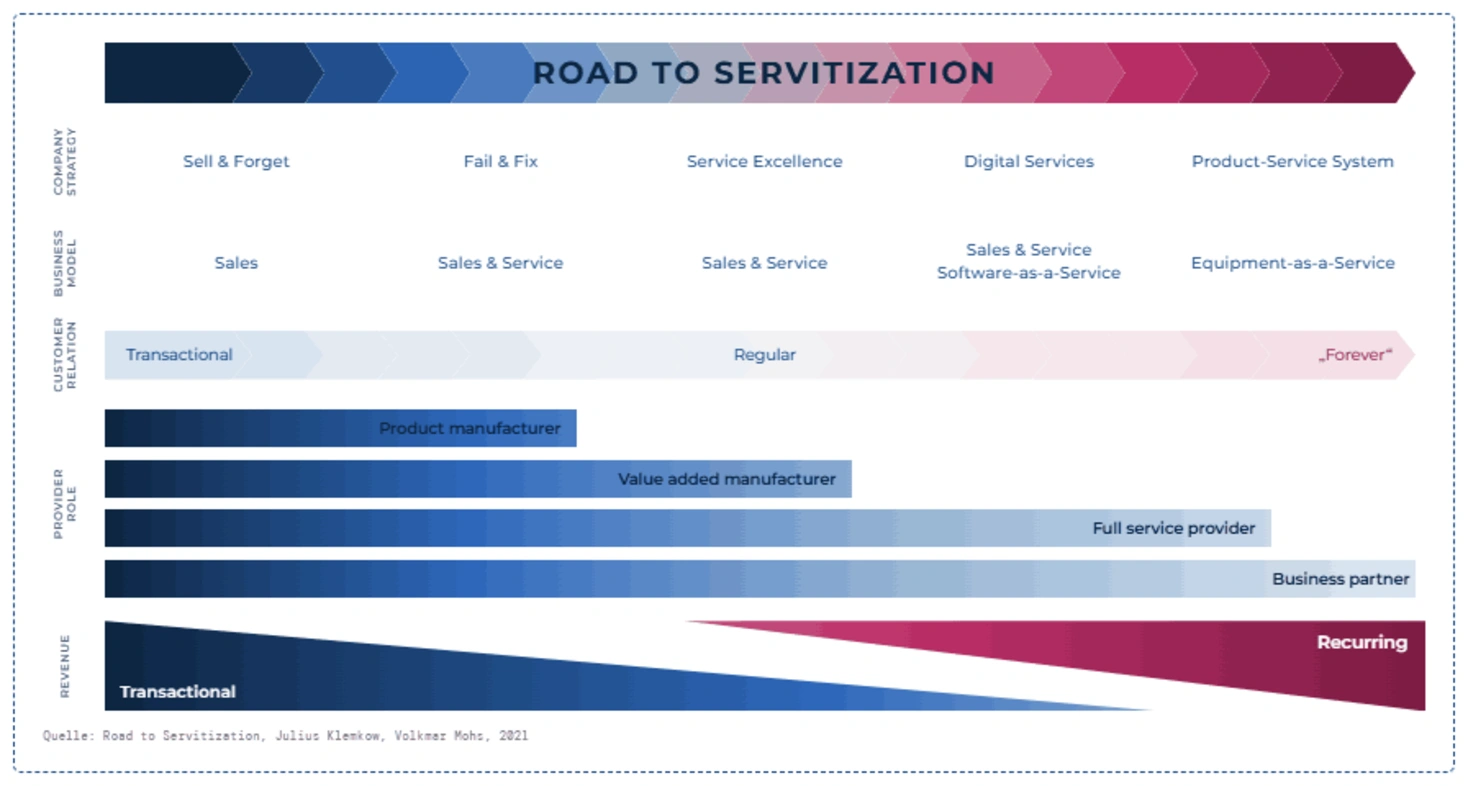
The strategic transformation process by which a product-centric manufacturing company expands into services, shifting from selling products to delivering integrated product-service solutions. Servitization is the journey; EaaS is one of the destinations.
The term has been in use since the 1980s, but gained significant momentum with IoT and digital technologies (often called “digital servitization”). Many companies face what Gebauer, Fleisch & Friedli first described in 2005 as the “service paradox” during this transformation – investing heavily in services without seeing proportional revenue and profit growth. Overcoming this paradox requires deliberate changes to organization, culture, sales incentives, and value propositions.
The intersection of digitalization and servitization, where connected products and digital technologies (IoT, AI, cloud platforms) enable new service business models that were previously inconceivable or economically unviable.
Digital servitization is the primary growth driver behind modern EaaS. Connected products allow remote monitoring, predictive maintenance, usage-based billing, and over-the-air updates – all of which reduce the marginal cost of service delivery toward zero. This makes EaaS models economically viable even for mid-sized manufacturers.
The umbrella term for all “as-a-service” business models, from Software-as-a-Service (SaaS) to Equipment-as-a-Service (EaaS), Mobility-as-a-Service (MaaS), and beyond. The “X” stands for any product or capability that can be delivered as a subscription-based or usage-based service.
Related: EaaS, SaaS, Movement-as-a-Service (MaaS)
A software distribution model where applications are hosted in the cloud and provided to customers on a subscription basis rather than as installed, purchased licenses. SaaS is the digital predecessor and reference model for EaaS.
SaaS demonstrated the economic power of recurring revenue models at scale. In a SaaS model, the software provider owns and operates the software, assuming all operating costs and risks over the product lifecycle. This same logic – shifting total cost of ownership from customer to provider – is what EaaS applies to physical equipment. Understanding SaaS economics (churn, ARR, NRR, LTV) is essential for EaaS practitioners.
Related: ARR, Churn Rate, Net Revenue Retention
An integrated combination of products and services designed to jointly fulfill a customer need. In a PSS, the physical product and the accompanying services are developed and delivered as a single coherent offering rather than as separate, independent transactions.
EaaS is a specific type of product-service system. The key insight is that the product alone rarely solves the full customer problem. A compressor solves only part of the customer’s need for compressed air – the full solution also requires installation, monitoring, maintenance, optimization, and sometimes financing. A PSS addresses the complete need.
Related: EaaS, Value Proposition
A strategic framework with four quadrants (physical product, physical service, digital product, digital service) that maps how manufacturing companies create value across hardware, software, and services. Developed by Wortmann, Gebauer, Lamprecht & Fleisch at the Bosch IoT Lab (University of St. Gallen / ETH Zurich).
The matrix reveals two fundamental forces: at the hardware-software boundary, every function that can be digitalized will be digitalized. At the product-service boundary, software moves toward cloud-based service delivery. Combined, these forces push manufacturers into the digital service quadrant – which offers the highest margins despite representing only a small share of revenue today.
Data from 194 European manufacturing companies show that in 2022, on average, 71% of revenue came from physical products, 23% from physical services and only 6% from digital products and services. Margins in the software and service quadrants, however, were many times higher than in the product business (Wortmann, Gebauer, Lamprecht & Fleisch, 2024, Fig. 3).
Related: Servitization, Digital Servitization
An EaaS model specific to the autonomous mobile robot (AMR) and automated guided vehicle (AGV) industry, where manufacturers offer robotic material handling as a service rather than selling robots outright.
The term is used by Agilox for its own offering and is not to be confused with Mobility-as-a-Service, which shares the abbreviation MaaS. The provider retains ownership, handles maintenance and software updates, and charges a combination of a base rate and a usage rate. This model removes the CAPEX barrier for warehouse and factory automation.
Agilox offers Movement-as-a-Service for their autonomous mobile robots. With more than 2,000 AMRs in use at customers including Siemens and BMW, Agilox charges a fixed base fee plus a usage fee per operating hour, with contract terms of 12 to 60 months.
Related: EaaS, Asset-as-a-Service
A structured management tool consisting of 66 patterns across seven steps that guides manufacturers through the process of developing a viable EaaS business model. The seven steps are: Set the Scope, Explore Customer Gains and Pains, Define Service Offering, Define Revenue Model, Investigate Strategic Rationale, Apply Proven Management Tactics, and Leverage Enabling Technology.
Developed by Wortmann, Gebauer, Lamprecht & Fleisch at the Bosch IoT Lab (University of St. Gallen / ETH Zurich) and validated through analysis of 200+ manufacturers. Published as a book (Understanding Products as Services, Emerald Publishing, 2024) and as a set of 66 physical pattern cards for use in workshops. The academic backbone includes peer-reviewed publications in Research-Technology Management (2022) and Industrial Marketing Management (2020).
Related: PaaS, Value Proposition
There is no single way to structure an Equipment-as-a-Service offering. These patterns define the scope – what exactly is being offered as a service.
An EaaS model based on a single machine or product. The provider maintains ownership and takes responsibility for servicing and management so the customer can focus on usage. Applicable regardless of whether the asset is movable or immovable, capital-intensive or not.
Lindner Recyclingtech offers industrial shredders through Performance-as-a-Service – recycling companies pay per operating hour with a guaranteed minimum usage commitment, instead of buying the machine. PistenBully follows a similar model for snow grooming equipment. Kaeser sells compressed air as a service. Gebr. Becker offers Vacuum-as-a-Service as a pure subscription model.
Related: Fleet-as-a-Service, EaaS
An EaaS model based on managing a fleet of multiple products for a customer. The focus shifts from individual asset performance to fleet-level optimization, availability, and lifecycle management.
Hilti Fleet Management – construction firms outsource the management of hundreds of power tools to Hilti, who handles procurement, repair, replacement, and logistics across the entire fleet.
Related: Asset-as-a-Service, OEE
An EaaS model based on a hardware or software component that is part of a larger machine or system. This applies to complex, failure-critical components where the provider takes responsibility for uptime and performance.
Rolls-Royce TotalCare for jet engines – airlines pay per engine flying hour (usage-based, not outcome-based). SKF’s Rotation for Life, where SKF takes responsibility for agreed performance targets of critical rotating equipment for a fixed monthly fee. Gebr. Becker’s Vacuum-as-a-Service for industrial vacuum pump systems.
Related: Asset-as-a-Service, Predictive Maintenance
An EaaS model based on consumable materials rather than the equipment itself. The provider takes over the complete management of consumables, eliminating the operational burden for the customer.
Michelin’s EFFITIRES – truck operators pay per kilometer of tire mileage while Michelin handles complete tire management, including procurement, mounting, monitoring, and replacement.
Related: Automatic Replenishment, Pay Per Consumable
A variant where the provider places a production machine on the customer’s site to produce consumables on demand. The customer does not buy or operate the machine but pays per unit of consumable produced.
5-Cent Energy/Alumero places solar installations at customer sites. Instead of buying panels, customers pay per kWh of solar power delivered. Packsize places box-making machines at customer sites and charges per box produced.
Additional software features or capabilities layered on top of connected equipment and offered as a recurring subscription. These extend the core functionality of the physical product.
John Deere’s proactive machine monitoring software, offered on top of the purchased machine.
Related: Over-the-Air Updates, SaaS
How Equipment-as-a-Service providers monetize their offerings. The revenue model must be closely aligned with the customer’s value drivers – not just the provider’s cost structure.

A framework that maps EaaS pricing as a continuum from pure subscription (fixed fee, guaranteed access) to pure usage-based (variable, metered). In practice, almost every real EaaS contract is a hybrid – a mix of fixed and variable components. The ratio between fixed and variable determines where on the spectrum a contract sits.
The spectrum is not a maturity ladder. A hybrid model is not “less advanced” than a fully usage-based one – it is a different risk allocation. Jumping straight to the usage-based end of the spectrum without the operational control, IoT infrastructure, and billing capabilities required is a common reason why EaaS pilots fail. The right starting point for most manufacturers sits somewhere in the hybrid zone – and that is where most successful models have landed. A pure pay-per-outcome model, often discussed at the theoretical far end of the spectrum, does not exist at scale in industrial equipment manufacturing today.
See diagram: The EaaS Pricing Spectrum with five Pioneer examples across the full spectrum.
Pioneer examples across the spectrum (left to right): Gebr. Becker – Vacuum-as-a-Service as pure subscription. Lindner Recyclingtech – Performance-as-a-Service at EUR per operating hour with minimum usage commitment. PistenBully – same pattern, EUR per operating hour with minimum usage commitment. Agilox – Movement-as-a-Service as base fee plus usage. 5-Cent Energy – Solar-as-a-Service at EUR per kWh, near pure usage.
Related: Subscription, Pay Per Use, Pay Per Outcome, Pay Per Performance
A revenue model where customers pay a recurring fee (weekly, monthly, quarterly, or annually) for access to equipment or specific functions, regardless of actual usage. The full fee is charged whether the equipment is used intensively or not.
Subscriptions are the simplest EaaS revenue model. They provide maximum revenue predictability for the provider but transfer minimal risk to the provider. In pure form, subscription models are a form of “pay for availability” rather than “pay for value.”
See diagram in: EaaS Pricing Spectrum (left end).
Gebr. Becker offers Vacuum-as-a-Service as a pure subscription. Customers pay a recurring fee for guaranteed vacuum availability and bundled services, regardless of how intensively they use the system. The subscription covers maintenance, monitoring and service – usage volume does not change the fee.
Related: EaaS Pricing Spectrum, Pay Per Use, ARR, Recurring Revenue
See diagram in: EaaS Pricing Spectrum (hybrid zone to right end)
5-Cent Energy‘s Solar-as-a-Service charges per kWh of energy delivered – the purest form of pay per use with no base fee. Agilox Movement-as-a-Service charges a base rate plus a fee per operating hour. Lindner Performance-as-a-Service and PistenBully both charge per operating hour with a guaranteed minimum usage commitment – the floor protects the provider’s investment while the variable rate scales with the customer’s actual operation.
See diagram in: EaaS Pricing Spectrum (theoretical far end).
Rolls-Royce TotalCare is often cited as outcome-based, but the billing unit is flying hours (usage), not successful flights (outcome). Kaeser bills per cubic metre of compressed air – also usage, not outcome. The distinction matters: usage-based means “pay for how much you use.” Outcome-based would mean “pay only if a defined business result is achieved.”
A revenue model where the customer pays based on how well the EaaS provider delivers against agreed performance metrics. This represents the theoretical far end of the pricing spectrum. In practice, performance elements typically appear as SLA penalties or bonuses within hybrid contracts rather than as standalone pricing models.
See diagram in: EaaS Pricing Spectrum (theoretical far end).
SKF’s Rotation for Life shows how performance elements typically appear in practice: customers pay a fixed monthly fee, while SKF commits to agreed performance targets for critical rotating equipment. This is a hybrid with performance commitments, not pure pay per performance.
A revenue model where the customer receives equipment free of charge (or at a subsidized rate) and pays only for the consumables used with it. The equipment cost is amortized through the margin on consumables.
Kaffeecenter in Switzerland provides offices with JURA fully automatic coffee machines free of charge and bills only for the coffee actually consumed. Heidelberg’s printing presses use a pay per sheet model.
Related: Consumable-as-a-Service
A contractual provision in pay-per-use or pay-per-outcome models that requires the customer to pay for a minimum level of usage regardless of actual consumption. This limits the provider’s downside risk from variable payment models.
Pure pay per use models are very rare in practice. In Findustrial’s EaaS projects, most models include minimum usage levels, base fees, or floor payments to ensure a predictable revenue baseline. The minimum commitment often covers the provider’s fixed costs for maintaining the equipment on-site.
Lindner Recyclingtech’s Performance-as-a-Service charges per operating hour with a guaranteed minimum usage commitment. The floor covers the provider’s fixed costs, while the variable rate scales with the customer’s actual operation.
Related: Pay Per Use, Minimum Contract Term
A required minimum duration for the EaaS contract, designed to protect the provider’s upfront investment in deploying, installing, and commissioning equipment at the customer site.
Kaeser’s compressed air as a service is agreed as a long-term contract to justify the substantial initial investment in installing compressors at the customer’s facility.
Related: Minimum Usage, Enable Exit
A contractual option that allows the customer to terminate the EaaS contract before the minimum term ends, usually in exchange for a defined early termination fee. This limits the customer’s downside risk and can reduce initial hesitation to adopt EaaS.
Related: Minimum Contract Term, Churn Rate
Revenue that is expected to continue at regular intervals (monthly, quarterly, annually) from ongoing service contracts or subscriptions, as opposed to one-time transactional product sales. Recurring revenue is more predictable, more resilient to economic downturns, and commands higher company valuations from investors.
The shift from one-time to recurring revenue is one of the primary strategic rationales for EaaS. A company with 80% recurring revenue effectively starts each year with that portion “in the bank,” dramatically reducing vulnerability to demand fluctuations.
Related: ARR, MRR, Subscription
The financial language of Equipment-as-a-Service. Understanding these terms is critical for building viable business cases and communicating with CFOs on both the provider and customer side.
A large, one-time investment to acquire, upgrade, or maintain a physical asset. In the context of equipment purchases, CAPEX appears on the customer’s balance sheet as a fixed asset and is depreciated over time. CAPEX requires board-level approval in many organizations and competes with other strategic investments for budget allocation.
Converting CAPEX to OPEX is one of the most commonly cited customer benefits of EaaS, but it is rarely the primary reason customers choose EaaS. In Findustrial’s project experience, operational benefits (flexibility, reduced TCO, risk transfer, skilled worker shortage) are the primary drivers.
Related: OPEX, TCO, Off-Balance-Sheet
Ongoing, recurring costs for running day-to-day business operations. In EaaS, the customer’s equipment cost transforms from a one-time CAPEX purchase into predictable, manageable OPEX payments that typically do not require the same level of capital approval. Whether the contract also stays off the customer’s balance sheet depends on its structure and the accounting framework (see Off-Balance-Sheet Financing).
Related: CAPEX, Off-Balance-Sheet
The complete lifecycle cost of equipment including purchase price, installation, training, maintenance, repairs, consumables, spare parts, downtime costs, procurement overhead, energy consumption, and disposal. TCO captures both direct and indirect costs that the purchase price alone does not reflect.
A critical learning from EaaS implementations is that customer adoption hinges on demonstrating a lower TCO compared to traditional purchase models. The convenience and flexibility of EaaS are attractive, but they are rarely enough on their own to justify switching. Successful EaaS offerings reduce not just direct costs but also indirect costs such as procurement overhead, maintenance coordination, and downtime risk.
A financial arrangement where assets and associated liabilities do not appear on the customer’s balance sheet. In certain EaaS structures where the provider retains ownership and the contract qualifies as a service agreement (rather than a lease under IFRS 16 or ASC 842), the equipment stays off the customer’s balance sheet.
Off-balance-sheet treatment is a valuable but nuanced benefit. Accounting standards (particularly IFRS 16) have made it more difficult to achieve true off-balance-sheet treatment for usage-based contracts. The key factors are contract duration, payment structure, and whether the arrangement qualifies as a lease or a service. Professional accounting advice is essential.
Related: CAPEX, OPEX, Refinancing
The process by which an EaaS provider moves the financing of its equipment to a third-party partner (bank, leasing company, or special purpose vehicle) while retaining the customer relationship and service delivery responsibility. Whether financial risk is transferred as well depends on the structure: with recourse, residual value guarantees or buy-back commitments, the economic risk stays with the manufacturer. Refinancing is critical for scaling EaaS because it frees the provider from funding every deployed asset from its own capital.
Without refinancing, every new EaaS contract requires the manufacturer to carry the full asset value on their balance sheet. This creates a structural scaling barrier. A refinancing framework facility – pre-arranged with financing partners – is a prerequisite for moving beyond pilot phase into scaled EaaS operations.
Related: SPV, Off-Balance-Sheet, Fish Model
A legally separate entity created specifically to own and finance EaaS equipment assets. The SPV holds the equipment, receives the recurring payments from customers, and is funded by financing partners. This structure isolates financial risk legally from the manufacturer’s main business (bankruptcy remoteness). On the balance sheet this does not happen automatically: if the manufacturer controls the SPV, it is consolidated under IFRS 10. Relief only arises when control and the significant risks actually sit with the financing partner (true sale).
Related: Refinancing, Off-Balance-Sheet
The estimated worth of equipment at the end of an EaaS contract period. Residual value management is a critical component of EaaS economics because it directly impacts contract pricing, profitability, and second-life strategies. Accurate residual value forecasting requires deep knowledge of equipment degradation patterns, market demand for used equipment, and refurbishment economics.
Related: Circular Economy, TCO
The ratio of net profit to total investment, used in the EaaS context to demonstrate to potential customers that switching from equipment purchase to EaaS will generate a measurable financial return. Provable ROI cases are one of the most effective go-to-market tactics for EaaS.
Urban Volt and Signify tie their light as a service value proposition to guaranteed electricity savings, creating a transparent “no-brainer” ROI case for customers.
Related: TCO
Traditional sales KPIs do not capture the dynamics of an EaaS business. These are the metrics that matter for managing and scaling Equipment-as-a-Service.
The annualized value of all active recurring EaaS contracts. ARR normalizes contract values to a 12-month basis regardless of actual contract duration or billing frequency. It is the single most important top-line metric for an EaaS business.
Related: MRR, DARR, Recurring Revenue
The monthly equivalent of ARR. MRR is the sum of all recurring monthly payments from active EaaS contracts. It provides a more granular, short-term view of revenue performance and is useful for tracking month-to-month growth and identifying trends.
Related: ARR
The annual recurring revenue specifically attributable to equipment that is actually deployed and in active use at customer sites. DARR excludes contracted but not-yet-deployed equipment, providing a more accurate picture of real revenue generation.
Related: ARR
The percentage of customers (or revenue) that terminates their EaaS contracts within a given period. Churn directly erodes recurring revenue and is one of the most critical metrics to monitor because acquiring new EaaS customers is typically far more expensive than retaining existing ones.
Related: Net Revenue Retention, Stickiness
Also: Net Dollar Retention (NDR)
A metric that measures how revenue from existing customers develops over time, factoring in expansions (upsells, cross-sells), contractions (downgrades), and churn. NRR above 100% means the EaaS business is growing even without acquiring new customers – existing customers are spending more over time.
NRR is becoming increasingly relevant for EaaS businesses because it captures the full revenue lifecycle dynamic. A company with 120% NRR effectively replaces 100% of its starting revenue plus grows 20% purely from its existing customer base.
Related: Churn Rate, ARR
The ratio of total expected revenue from an EaaS contract over its lifetime divided by the total cost of the equipment (bill of materials) plus cumulative service costs. This metric indicates the value potential of an EaaS offering.
Related: TCO, Gross Payback Period
The time required for cumulative EaaS payments from a customer to cover the initial cost of deploying the equipment. A shorter payback period reduces financial risk and improves return on invested capital.
Related: LTV to BOM, Fish Model
A manufacturing productivity metric calculated as the product of three factors: Availability (uptime vs. planned production time), Performance (actual throughput vs. theoretical maximum), and Quality (good units vs. total units produced). OEE measures how effectively equipment is being used.
Improving customer OEE is one of the most compelling value propositions for EaaS. When an OEM retains responsibility for equipment performance through an EaaS model, they gain deep operational insights that enable them to optimize availability, reduce unplanned downtime, and continuously improve equipment design.
Related: Predictive Maintenance, Remote Monitoring
A customer loyalty metric. Customers rate on a scale from 0 to 10 how likely they are to recommend the EaaS offering. The NPS is the percentage of promoters (9-10) minus the percentage of detractors (0-6), so the result ranges from -100 to +100. In the EaaS KPI framework, NPS sits within the service perspective and is a leading indicator of future churn or expansion.
Related: Churn Rate
The digital technologies that make modern Equipment-as-a-Service economically viable. Technology is an enabler, not a prerequisite – but it is what has made EaaS scale.
The network of physical objects embedded with sensors, software, and connectivity that enables them to collect and exchange data. In the EaaS context, IoT is the foundational technology that connects equipment at customer sites to the manufacturer’s digital infrastructure, enabling remote monitoring, usage-based billing, predictive maintenance, and continuous improvement.
IoT automates the interface between the physical and digital worlds. The marginal cost of collecting data from connected equipment drops toward zero, which fundamentally changes what services are economically viable. Important: IoT connectivity is not a prerequisite for EaaS. Many successful EaaS offerings (including Hilti’s fleet management) operated for years without connected products.
Related: Digital Twin, Remote Monitoring
A digital representation of a physical asset that is continuously synchronized with the real-world object through automatic data exchange. A digital twin consists of three building blocks: the physical object, its digital representation (in an information system), and the automatic data synchronization between them.
Digital twins are the fundamental building block of every hybrid customer solution in EaaS. They merge the benefits of the physical equipment with the benefits of its digital representation – enabling remote monitoring, simulation, optimization, and data-driven decision making without requiring physical presence at the equipment.
Related: IoT, Remote Monitoring
The ability to observe equipment conditions, performance, and error states from a central location without sending technicians to the customer site. Remote monitoring is the most fundamental IoT use case for EaaS and the starting point for most connected equipment strategies.
Nordex monitors its installed wind turbine fleet centrally through remote monitoring, achieving cost-effective fleet oversight at scale.
Related: Remote Access, Remote Support
The ability to remotely control equipment to install software packages, adjust parameters, restart machines, or perform diagnostic procedures. Remote access goes beyond passive monitoring to enable active intervention without physical presence.
Related: Remote Monitoring, Remote Support
The use of technology (video calls, augmented reality, smart glasses) to help on-site customers fix equipment problems themselves, guided remotely by expert service technicians. Remote support avoids the cost and delay of dispatching technicians to customer sites.
Beumer Group equips operators of its systems with smart glasses, enabling remote experts to see what on-site staff see and give precise real-time instructions.
Related: Remote Access
The use of data analytics and machine learning algorithms to identify patterns in equipment sensor data that indicate potential failures before they occur. Unlike preventive maintenance (which follows fixed schedules), predictive maintenance intervenes only when the data signals an actual developing issue.
Predictive maintenance transforms unplanned downtime into planned maintenance windows. For EaaS providers, this is a direct profitability lever: reducing unplanned service calls, extending equipment life, and improving customer satisfaction simultaneously.
Related: Remote Monitoring, OEE, Digital Twin
The ability to deploy software updates (bug fixes, security patches) and upgrades (new features, performance improvements) to equipment remotely via wireless connectivity. OTA eliminates the need to physically visit each machine for software changes.
OTA is a game-changer for EaaS because it means the equipment can improve over time – the opposite of traditional depreciation. New features can be deployed, performance can be optimized, and bugs can be fixed across an entire fleet with a single deployment. Some manufacturers (like Porsche with Taycan) even sell OTA upgrades as additional revenue streams.
Related: Software Add-on-as-a-Service
Sensor-based automated reordering of consumables when inventory levels drop below a defined threshold. This eliminates manual stocktaking and prevents both stockouts (which halt production) and excessive inventory (which ties up capital).
Related: Consumable-as-a-Service, IoT
The end-to-end process from receiving an EaaS order through delivery, usage tracking, billing, and payment collection. Traditional ERP systems designed for one-time product sales often cannot handle the complexity of recurring, variable, usage-based EaaS billing at scale. Dedicated subscription management or EaaS platform solutions are typically required.
Related: Recurring Revenue
A six-layer framework for understanding how connected products create value: (1) Physical Product, (2) Sensor Technology, (3) Connectivity, (4) Data Storage, (5) Analytics, (6) Digital Smart Service. Layers 1-3 belong to the physical/hardware world; layers 4-6 belong to the digital/software world. Only layers 1 and 6 are directly visible to customers.
Related: IoT, Digital Twin
The strategic concepts, transformation patterns, and management tactics that determine whether an Equipment-as-a-Service initiative succeeds or fails.
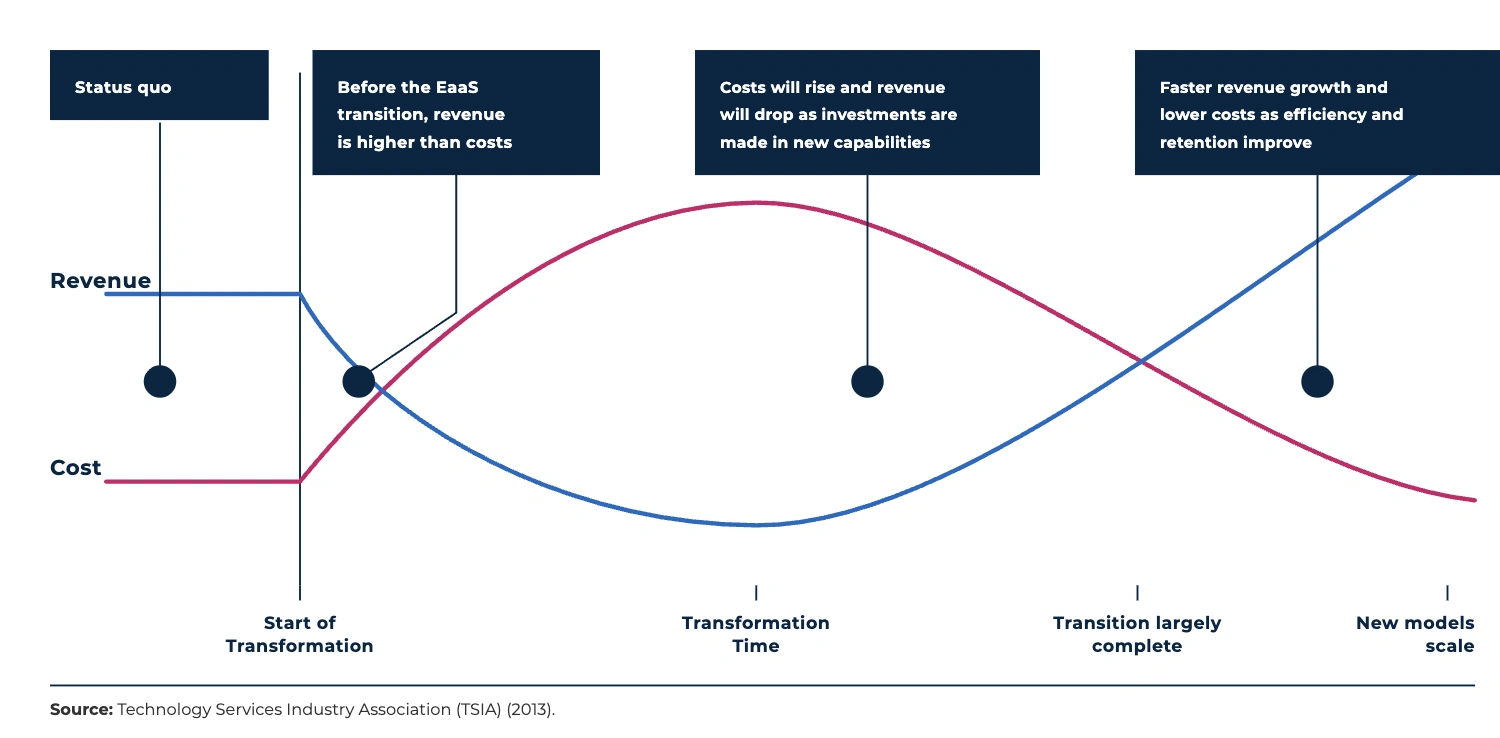
A visualization of the financial gap that occurs when a company transitions from one-time product sales to recurring EaaS revenue. During the transition, revenue temporarily drops (as large lump-sum payments are replaced by smaller recurring fees) while costs rise (due to investments in new capabilities, infrastructure, and equipment ownership). The resulting revenue-cost chart forms a “fish” shape. Successfully navigating this period is called “swallowing the fish.”
Described in detail in Wortmann, Gebauer, Lamprecht & Fleisch (2024). The fish model is one of the most common reasons companies hesitate to pursue EaaS. Practical experience from Findustrial’s 75+ EaaS projects shows the fish can be kept small: starting with a single pilot customer, expanding gradually, and collaborating with refinancing partners to share the burden. Companies do not need to swallow the fish whole – they can take bite-sized steps.
Related: Refinancing, Service Journey, Gross Payback Period | Deep Dive: The full EaaS guide
The phenomenon where manufacturing companies invest heavily in building service capabilities but fail to see proportional returns in revenue and profit growth. First described by Gebauer, Fleisch & Friedli (2005, European Management Journal) based on research with more than 30 equipment manufacturers, the service paradox occurs when companies expand into services without establishing clear service development processes, dedicated value propositions, adapted marketing and revenue models, separate service organizations with P&L responsibility, or a viable service culture.
Related: Servitization, Digital Servitization
A stepwise approach to transitioning customers from product purchase to comprehensive EaaS, through a series of progressively more advanced service offerings. Rather than asking customers to make the leap from buying equipment to fully managed EaaS in one step, providers take them through intermediate stages.
Komptech offers all three models – purchase, short-term rental, and EaaS – as parallel options for different customer needs, allowing customers to enter at any level.
Related: Trojan Horse, Freemium
A go-to-market tactic where the EaaS provider enters the customer relationship through a small, low-risk offering that solves an immediate pain point, then expands the scope over time into broader EaaS engagement. The initial offering creates trust and demonstrates value.
Related: Service Journey, Freemium
A go-to-market strategy where basic features or a limited version of an EaaS offering are provided free of charge, while premium features, higher usage levels, or comprehensive service coverage require a paid subscription. In the physical EaaS world, freemium typically applies to digital add-on services layered on top of sold equipment.
Related: Service Journey, Trojan Horse, Software Add-on
The degree to which an EaaS offering becomes deeply integrated into the customer’s core business processes, making it difficult and costly for the customer to switch providers. High stickiness improves retention and reduces churn, which is a critical success factor for EaaS profitability.
EaaS providers deliberately increase stickiness by deeply integrating their solution into customer workflows, providing proprietary data analytics the customer depends on, and building switching costs through customization and training. Unlike traditional product sales, stickiness in EaaS directly impacts recurring revenue quality.
Related: Churn Rate, NRR
The specific, quantifiable benefit that an EaaS offering delivers to the customer compared to traditional equipment ownership. An EaaS value proposition must go beyond generic financial benefits (CAPEX to OPEX) and address specific customer pains: reduced TCO, higher OEE, risk transfer, flexibility, skilled worker shortage, or aligned incentives.
Related: TCO, OEE | Deep Dive: Stop Selling “No CAPEX”
The percentage of a customer’s total spending in a category that goes to a specific EaaS provider. EaaS models inherently increase share of wallet because they bundle equipment, services, spare parts, consumables, and sometimes financing into a single contract – revenue streams that were previously split across multiple vendors.
Related: Recurring Revenue
A contractual commitment defining the specific performance standards, availability guarantees, response times, and resolution targets that the EaaS provider must meet. SLAs are the foundation of EaaS contracts because they define what the customer is actually paying for – outcomes and performance, not just access to equipment.
Related: Pay Per Performance, OEE
The transfer of demand-side risk from the equipment customer to the EaaS provider. When customer demand declines, equipment utilization drops. In a pay-per-use model, this means the customer’s equipment costs automatically decrease – the provider absorbs the downside risk of underutilization.
Related: Operational Risk Transfer, Pay Per Use
The transfer of equipment performance risk from the customer to the EaaS provider. If the equipment breaks down, underperforms, or fails to deliver expected output, the provider bears the consequences – through reduced payments, contractual penalties, or the cost of remediation.
Related: Business Risk Transfer, SLA
The simplest version of an EaaS offering that can be deployed with a real customer to validate the business model, test pricing, and learn from actual market feedback. In EaaS, launching an MVP with a real customer is critical because only real customer feedback can validate whether the offering solves a genuine problem worth paying for.
A key learning from EaaS implementations is that the model “takes off on execution, not on PowerPoint.” Only companies that successfully launched initial EaaS use cases with real customers were able to build the momentum needed for broader transformation.
Related: Fish Model, Service Journey
The comprehensive transformation of sales capabilities required to sell EaaS effectively. Traditional sales teams trained to close one-time equipment transactions need new skills, tools, incentive structures, and mindset to sell value over time rather than products. This includes consultative selling, understanding customer P&L, articulating lifecycle value, and compensation models that reward recurring revenue creation.
Sales enablement is one of the most underestimated challenges in EaaS implementation. Without the right training, compensation, and support, even the best-designed EaaS offering will fail to gain market traction because sales teams will default to selling what they know: one-time equipment deals.
Equipment-as-a-Service and the circular economy are deeply connected. When manufacturers retain equipment ownership, they have both the incentive and the ability to maximize asset utilization and lifecycle value.
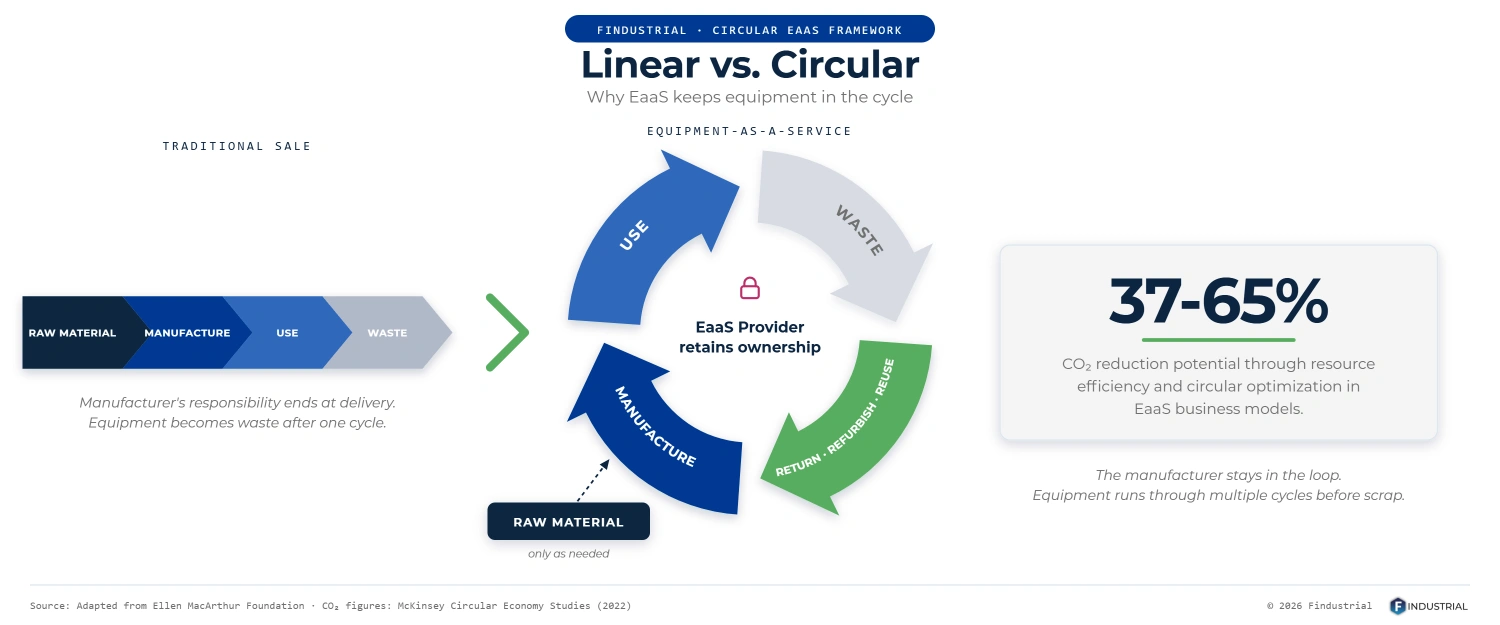
An economic model that aims to decouple prosperity from the consumption of finite resources, guided by three principles: prevention of waste and pollution, maximum reuse of products and materials at their highest value, and regeneration of nature. EaaS contributes to the first two principles by placing lifecycle responsibility with the manufacturer.
When a company retains ownership of equipment through EaaS, it is economically incentivized to ensure the equipment delivers value for as long and as intensively as possible. This creates a natural alignment between business incentives and sustainability goals that does not exist in traditional sell-and-forget models.
Lindner Recyclingtech offers industrial shredders through Performance-as-a-Service. When a customer contract ends or needs change, the shredder returns to Lindner. It can be maintained and prolonged in operation, refurbished and redeployed to the next customer, or – only at true end of life – dismantled and recycled. The same physical asset can serve three or more customers across its lifecycle.
Related: Residual Value, Second Life | Deep Dive: EaaS as Sustainability Strategy
A visualization from the Ellen MacArthur Foundation illustrating the circular economy through two cycles: the technical cycle (durable goods like machinery, electronics, metals) with four loops of decreasing value retention – maintain/prolong, reuse/redistribute, refurbish/remanufacture, and recycle – and the biological cycle (consumables, biodegradable materials) with composting, anaerobic digestion, and return to biosphere. EaaS for industrial equipment operates exclusively in the technical cycle.
The biological cycle is outside the scope of industrial equipment manufacturing – shredders, vacuum pumps, AMRs, and audio systems are technical assets. For the canonical version of the diagram, see the Ellen MacArthur Foundation’s interactive Butterfly Diagram. For Findustrial’s simplified visualization that focuses on the technical cycle relevant to EaaS, see Circular Economy.
Related: Circular Economy
The redeployment or refurbishment of equipment after the end of its initial EaaS contract for use by another customer, in another market, or at a lower performance tier. Second-life strategies are critical to EaaS economics because they recover residual value and reduce the effective cost of ownership for the EaaS provider.
A Lindner shredder returned after the first EaaS contract can be refurbished and redeployed to a different recycling operator with different throughput needs. An electric vehicle battery that no longer meets automotive performance standards may still have a profitable second life as stationary energy storage. Second life is what makes the circular economy economically viable – not just environmentally desirable.
Related: Residual Value, Circular Economy
The framework for evaluating a company’s environmental and social impact and governance practices. EaaS models can contribute positively to ESG metrics by extending equipment lifecycles, reducing waste, enabling more efficient resource utilization, and providing transparent sustainability data through connected equipment.
Related: Circular Economy
This platform is tailored for equipment buyers and operators who want to apply for flexible asset financing.
Findustrial specializes in EaaS | flexible-finanzierung.at covers all financing services beyond EaaS.
You are currently viewing a placeholder content from Accessibility Widget. To access the actual content, click the button below. Please note that doing so will share data with third-party providers.
More InformationYou are currently viewing a placeholder content from Vimeo. To access the actual content, click the button below. Please note that doing so will share data with third-party providers.
More InformationYou are currently viewing a placeholder content from YouTube. To access the actual content, click the button below. Please note that doing so will share data with third-party providers.
More InformationYou need to load content from reCAPTCHA to submit the form. Please note that doing so will share data with third-party providers.
More InformationYou are currently viewing a placeholder content from Hubspot Embedded Content. To access the actual content, click the button below. Please note that doing so will share data with third-party providers.
More InformationYou are currently viewing a placeholder content from HubSpot. To access the actual content, click the button below. Please note that doing so will share data with third-party providers.
More InformationYou are currently viewing a placeholder content from Hubspot Meetings. To access the actual content, click the button below. Please note that doing so will share data with third-party providers.
More Information