
Equipment-as-a-Service refinancing is how a manufacturer funds equipment that customers pay for by the month instead of buying it outright. The cost lands on day one, the revenue arrives over three to five years, and someone has to fund the gap in between.
The structure decides three things: who holds the asset, whose balance sheet it lands on, and who carries residual value risk and credit risk. Which structure fits a given manufacturer is what the Findustrial EaaS Refinancing Analysis works out: eight strategic goals, ranked, and matched to a structure.
OEM customers
Findustrial
Findustrial
Refinancing partners
This post is also available in: German
Selling a machine converts one asset into cash more or less on the day of delivery. Offering the same machine as a service does the opposite: you keep the asset, you keep the cost, and the revenue arrives in monthly installments over three to five years. The first year of an Equipment-as-a-Service program therefore looks worse on paper than the business you already had, even when every individual contract is profitable.
That shape has a name. Thomas Lah and J. B. Wood named it “swallowing the fish” in the Technology-as-a-Service Playbook: costs rise before recurring revenue catches up, and the gap between the two curves is the period a manufacturer has to fund. The pattern is well documented. What the literature does not answer is the practical question that follows: who puts up the money for the gap.
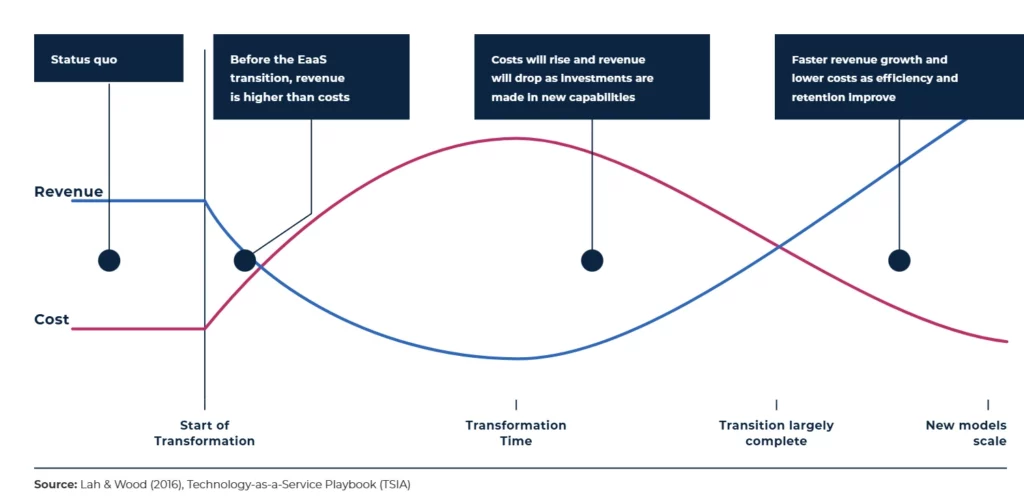
Findustrial illustration, after Lah, T. and Wood, J. B. (2016), Technology-as-a-Service Playbook, chapter 5, “Swallowing the Fish”. More terms in the Equipment-as-a-Service Glossary.
This is where programs stall. In our own first conversations with manufacturers, two of them independently described financing as the one hard question and everything else as comparatively easy to solve.
The objection we hear most often is not about the model at all. It is a version of “we are not a bank, we want to realize revenue”. That objection is correct, and it is exactly what refinancing answers: the one-off revenue can still be realized on delivery. What changes is who holds the asset afterwards.
Most comparisons of refinancing options open with a financing product list. That is the wrong end. Three questions decide which structures are open to you at all, and once you have answered them the list is short.
Question 1
You, a lessor, or a separate legal entity. Title decides who can pledge the machine as security and who has to remarket it at the end of the term. What it does not decide, on its own, is your balance sheet. That follows from the two questions below.
Decides: security and remarketing
Question 2
This is the question that gets skipped, and under IFRS it is the one that decides the balance sheet outcome. An entity you control is consolidated back into your group’s financial statements. Control comes from power over the relevant activities and exposure to variable returns, not from the size of your equity stake. A vehicle you do not control stays out. Legal separation and accounting separation can be two different things.
Decides: the IFRS balance sheet
Question 3
Two different risks, and they do not necessarily sit with the same party. This is the trade that sets your cost of funding: every risk you keep is cheaper, and every risk you hand over is one less reason for a deal to stall.
Decides: your cost of funding
The three structures below are the ones we use in practice. They are not a menu to pick from in order of preference. They are points on the three axes above, and most manufacturers move along those axes as the program grows.
Figure 2a

The asset goes to the lessor, you lease it back and stay the customer’s contract partner.
Figure 2b

You stay in the contract, the receivable moves. The only structure with a condition on your customer.
Figure 2c

A separate entity holds the assets and raises debt against them.
Figure 2 · How asset, money and contract move in each structure.
Table 1 · The three refinancing structures compared
| Sale and leaseback | Sale & assignment of receivables | SPV debt facility | |
|---|---|---|---|
| Who holds the asset | Lessor | Refinancing partner | The SPV |
| Who consolidates | Depending on applicable GAAP rules and contract structure | Most likely refinancing partner | Depends on your stake and chance/risk analyses |
| Customer credit check | None | Required, per customer | Per the facility's eligibility criteria |
| Requires from your customer | Nothing | Sufficient creditworthiness | Per the facility's eligibility criteria |
Findustrial’s own classification, drawn from our refinancing practice. No published comparison of these structures exists for the Equipment-as-a-Service case.
Which of the three is realistic for you depends on your volume, the asset itself and the markets you sell into. Most manufacturers start with the simpler structure and grow into the more demanding ones as the program grows.
One thing is worth pulling out of that table. In a sale & assignment of receivables, the refinancing partner buys your receivables, so it carries your customer’s credit risk. That is why each customer has to pass a credit check before their contract can be refinanced. In an SPV, whether customers are checked depends on the facility’s eligibility criteria.
“Equipment-as-a-Service is off balance sheet” is one of the most repeated sentences in this field. Whether it holds depends on which accounts you look at: your separate financial statements under local GAAP, or your consolidated financial statements under IFRS.
National · separate financial statements
Under local GAAP, such as the German HGB or the Austrian UGB, an asset you sell leaves your separate financial statements. That is the case in a sale and leaseback and in an SPV structure. In a sale and assignment of receivables, it depends on how the contract is set up. Rules differ from country to country, so have it checked for the framework you report under.
e.g. HGB (Germany) · UGB (Austria)
International · consolidated financial statements
Under IFRS, the consolidated financial statements look different. In a sale and leaseback, the lease comes back onto your balance sheet. An SPV you control is consolidated into your group. The consolidated balance sheet only stays clear if you do not control the SPV.
Groups reporting under IFRS
Table 2 · On or off the balance sheet, by accounting framework
| Asset off the balance sheet? | Local GAAP (e.g. HGB, UGB) separate financial statements | IFRS consolidated financial statements |
|---|---|---|
| Sale and leaseback | Yes | No |
| Sale & assignment of receivables | Depends on the contract | Depends on the contract |
| SPV debt facility · controlled by you | Yes | No |
| SPV debt facility · not controlled by you | Yes | Yes |
The SPV appears twice because under IFRS, whether you control it decides the outcome.
In round numbers: a fleet of 40 machines at €120,000 each is €4.8 million of equipment. Funded from your own balance sheet, it sits in your fixed assets and ties up the equity or the credit line behind it. The structure decides how much of that stays on your balance sheet while your customers pay monthly.
Machines in the fleet
Worked example
Per machine
Worked example
Equipment on your books
Worked example
We are not auditors. The binding assessment for your accounts rests with your auditor, and it should be obtained before the structure is built, not after the thirtieth contract.
The comparison above tells you what the three structures do. It does not tell you which one to run. That answer does not come from the structures. It comes from what you are trying to achieve, and in which order.
Two manufacturers with the same machines and the same customers end up in different structures, because they want different things first. One needs cash this quarter. The other needs the group balance sheet clear for an equity round. Same equipment, different answer.
So we run that decision as a structured exercise rather than a conversation. It is called the Findustrial EaaS Refinancing Analysis, and it has three steps.
Step 1
Name your strategic goals
Eight goals. Pick the three that matter most to your business.
Step 2
Put them in order
Ranking them is what turns a wish list into a decision.
Step 3
The structure follows
Read against your accounting framework, asset, markets and customers. This step we run with you.
Eight goals cover what manufacturers actually want out of a refinancing structure. You pick the three that matter most to your business. Each goal moves a different number, and that number is how you check later whether the structure did its job. They fall into two groups: what you optimize for your own business, and what you hand over to the refinancing partner.
What you optimize
Maximize short-term cash flow to secure liquidity.
Moves · Minimum cash · liquidity runway
What you hand over
Reduce the risk that your customer does not pay.
Moves · Bad debt % · DSO
What you optimize
Establish stable recurring revenue as a financing base.
Moves · Annual recurring revenue
What you hand over
Move the utilization risk in usage-based models to the refinancing partner.
Moves · Utilization risk
What you optimize
Realize sale and margin at the start, through a true sale of receivables or assets.
Moves · Revenue recognized at inception
What you hand over
Outsource residual value and technology risk on the equipment.
Moves · Residual value risk · contingent liabilities
What you optimize
Keep termination, term and pricing adjustable.
Moves · Number of contracts · average contract term
What you hand over
Keep the balance sheet light, avoid CapEx, hold the equity ratio stable.
Moves · Net debt · equity ratio
Figure 3 · The eight strategic goals of the Findustrial EaaS Refinancing Analysis.
Three goals is already more than you can optimize at once, and some of them pull against each other. Ranking them is what turns a wish list into a decision. The trade is the one named at the start of this article: every risk you keep is cheaper, and every risk you hand over is one less reason for a deal to stall. Your ranking decides which side of that trade you want to be on.
Once the ranking is on the table, the structure stops being a matter of preference. It follows from the ranking read against four facts about your business: the accounting framework you report under, how standardized the asset is, the markets you sell into, and the credit profile of you and your customers. What comes out is not a single verdict but a starting point and a direction: the structure that carries your first contracts, and the one you grow into. That is the step we go through with you, because it runs on your figures rather than on a table.
What you can do before that call is step one and step two. Pick your three goals, put them in order, and bring the ranking. That is the input everything else runs on.
A confusion worth clearing up in two sentences, because it costs manufacturers real options: the structure you choose to fund the fleet does not constrain how you charge your customer.
A fixed monthly subscription, a price per operating hour with a minimum, a base rate plus usage, or a tiered rate that falls as volume rises: all of them remain available under every structure above. The refinancing partner cares that the cash flow is predictable enough to underwrite, not that it is flat. That is what a contractual minimum is for, and it is the reason every usage-based model in practice has a floor.

The two sides are easy to confuse. Your customer’s capital problem is solved better and more cheaply by a financing partner, which is why “no CAPEX” does not win deals on its own. Your own refinancing is a different question, and it is the one that decides whether you can offer the model at all.
EaaS Value Propositions: Why "No CAPEX" Is Not Enough
It is how the manufacturer funds equipment while customers pay for use. Because the revenue arrives monthly over several years while the cost arrives on day one, the gap has to be funded by someone. Refinancing decides who that is, who holds the asset, and whose balance sheet it appears on.
It depends on the accounting rules. Under local GAAP, such as the German HGB or the Austrian UGB, an asset you sell leaves your separate financial statements, which is the case in a sale and leaseback and in an SPV structure. Under IFRS consolidated financial statements, a sale and leaseback brings the lease back onto your balance sheet, and an SPV you control is consolidated. The consolidated balance sheet only stays clear if you do not control the SPV. The binding assessment rests with your auditor.
Usually a sale and leaseback, because it needs no customer credit check, leaves contract changes and asset swaps with you, and works from a handful of contracts. The structures that free the consolidated balance sheet come with setup cost and minimum volumes that a pilot cannot carry. Alternatively, pilots can be funded by the manufacturer itself.
In general, no. Subscription, price per operating hour with a minimum, base rate plus usage and tiered pricing all remain available under each structure. What a refinancing partner needs is a predictable floor, not a flat rate.
Legally, yes. In the accounts, only if you do not control it. If you control it, it is consolidated into your group’s financial statements. Additionally, your relationship and your responsibilities for the SPV have to be considered.
The contract template you intend to use, the intended term and minimum commitment, evidence of how assets are attributed to contracts, and a view on who services the equipment if you cannot. Those four determine the answer faster than any presentation. Additionally, asset details, customer structure and your documents for a credit check will be asked for.
Through the Findustrial EaaS Refinancing Analysis. You pick up to three strategic goals out of eight, put them in order, and the ranking is matched to a structure against your accounting framework, your asset, your markets and your customer base. The first two steps you can do yourself. The third we run together in a refinancing call.
What makes a contract fundable
What stops a facility
The order matters more than the list. Bankability is a design decision taken at the first contract. Retrofitting it at the thirtieth means renegotiating with customers who have already signed, and that is the point at which programs lose a year.
We work with more than ten refinancing partners, among them F&S Leasing (Erste Group) and Raiffeisen Impuls Leasing, and the reason is not redundancy for its own sake. Different structures, asset classes and countries need different partners, and a program that depends on a single one inherits that partner’s coverage gaps.
The network behind the structures in this article.


Refinancing is not the part of Equipment-as-a-Service that comes after the model works. It is part of the design. The structure you pick determines what you can promise a customer, what your auditor will say about your balance sheet, and whether the program survives contract number thirty.
Three questions get you most of the way: who holds the asset, who consolidates, who carries the risk. The fourth question, what it costs, only becomes answerable once those three are settled. Which structure settles them best for you follows from your goals, and that is what the Findustrial EaaS Refinancing Analysis is for.
A 30-minute conversation covers your asset base, your accounting framework and your customer profile, and ends with the structures that are actually available to you.
Monthly EaaS Insights – compact, relevant, actionable.
You are currently viewing a placeholder content from HubSpot. To access the actual content, click the button below. Please note that doing so will share data with third-party providers.
More InformationDisclaimer
This article is for general information only and does not constitute legal, tax, accounting or financial advice. Accounting, tax and legal rules differ from country to country and change over time, so the treatment described here may not apply to your situation. Have any specific structure assessed by your auditor, tax adviser or legal counsel before you act on it. We have prepared this content with care, but to the extent permitted by law Findustrial GmbH accepts no liability for its accuracy, completeness or currency, or for decisions taken on the basis of it.
This platform is tailored for equipment buyers and operators who want to apply for flexible asset financing.
Findustrial specializes in EaaS | flexible-finanzierung.at covers all financing services beyond EaaS.
You are currently viewing a placeholder content from Accessibility Widget. To access the actual content, click the button below. Please note that doing so will share data with third-party providers.
More InformationYou are currently viewing a placeholder content from Vimeo. To access the actual content, click the button below. Please note that doing so will share data with third-party providers.
More InformationYou are currently viewing a placeholder content from YouTube. To access the actual content, click the button below. Please note that doing so will share data with third-party providers.
More InformationYou need to load content from reCAPTCHA to submit the form. Please note that doing so will share data with third-party providers.
More InformationYou are currently viewing a placeholder content from Hubspot Embedded Content. To access the actual content, click the button below. Please note that doing so will share data with third-party providers.
More InformationYou are currently viewing a placeholder content from HubSpot. To access the actual content, click the button below. Please note that doing so will share data with third-party providers.
More InformationYou are currently viewing a placeholder content from Hubspot Meetings. To access the actual content, click the button below. Please note that doing so will share data with third-party providers.
More Information